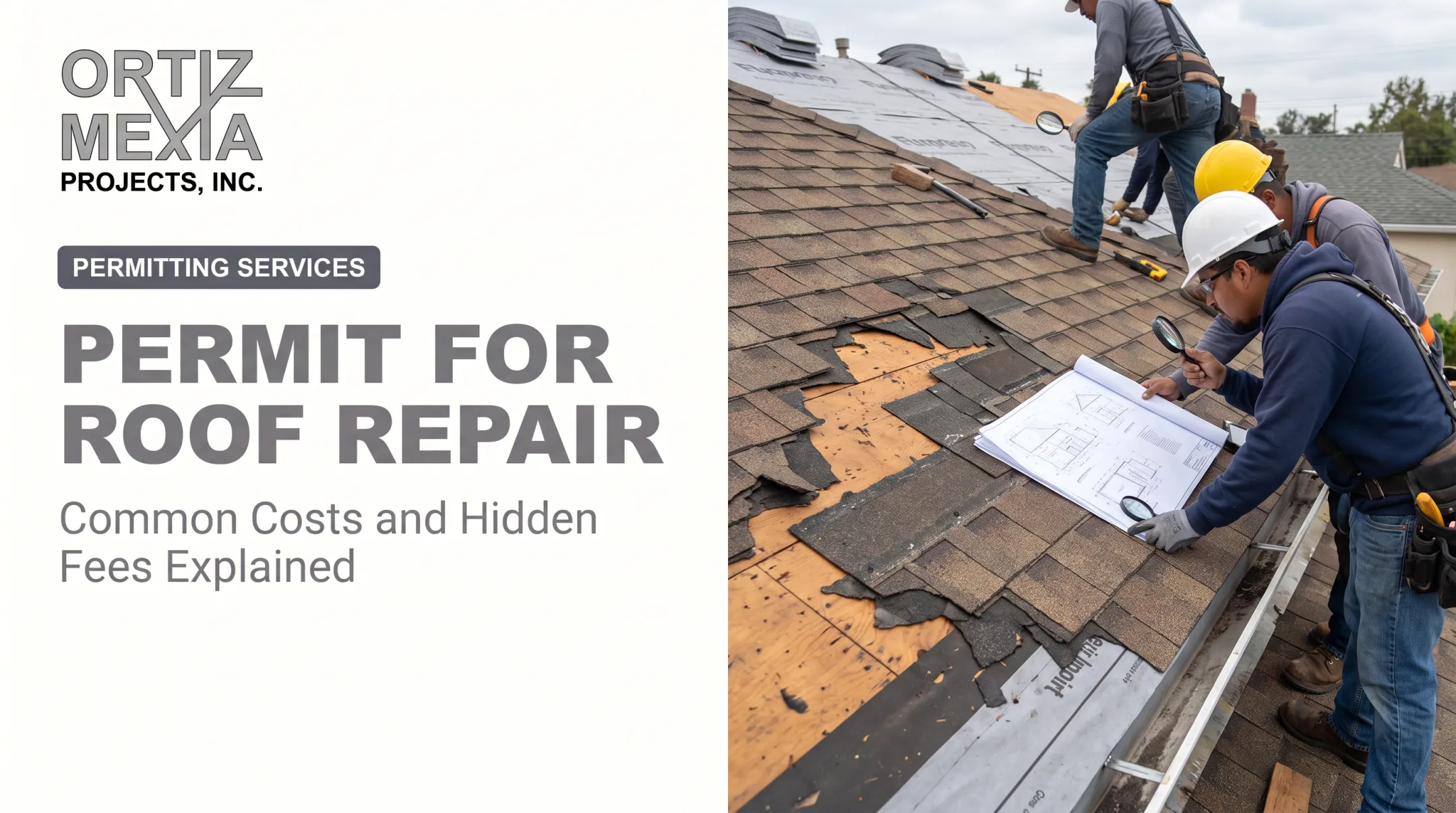

A full roof replacement commonly requires a permit in the United States, but the final call belongs to your local building department. Costs and rules vary by location, roof size, project value, structural scope, and materials. That's different from the cost of the roof itself.
This guide breaks down permit fee ranges, requirement patterns by state, the application process, and what happens when homeowners skip this step entirely.
Key Takeaways
- Flat reroof permit fees often run $90 to $342; some places charge a share of project value instead.
- Expect higher fees when roof size, structural work, material changes, property type, or local overlay rules apply.
- A simple reroof costs and requires far less than deck replacement, framing changes, solar work, or historic-property projects.
- Confirm rules with your local building department before work begins, and decide who pulls and closes the permit.
How Much Does a Roof Replacement Permit Cost?
There's no single national permit price. Fee schedules may be flat, based on roof square footage, based on construction value, or a mix of all three.
Published municipal fee schedules show a wide range:
| Jurisdiction | Fee Structure | Source & Date |
|---|---|---|
| Clarence, NY | Flat $100 residential fee; $200/visit for incomplete inspections | 2024 fee schedule |
| Corcoran, MN | Flat $90 + $1 state surcharge, plus 65% plan-review fee | 2025 fee schedule |
| Orange County, CA | Flat $295–$342 depending on fiscal year | 2024 agenda packet |
| Flagler Beach, FL | Value-based: $7.50 per $1,000 up to $5M, $45 minimum | Ordinance 2024-17 |

Most jobs fall into one of three tiers:
- Basic — straightforward reroof, no structural changes, flat or low-tier fee
- Standard — plan review, moderate documentation, single-family scope
- Complex — structural changes, heavier materials, solar, multiple inspections, or special-zone review
The permit fee rarely includes design drawings, engineering calculations, contractor administrative charges, expedited review, or separate trade permits for electrical or solar work.
Cost Breakdown of a Roof Replacement Permit
Expect the total permitting spend to include more than the sticker fee:
- Application or issuance fee — flat rate, per square foot, or tied to project value, based on your local formula
- Plan review and inspections — sometimes bundled; sometimes billed apart. Denver’s schedule covers customary inspections, but reinspections and after-hours visits cost extra
- Outside costs — engineering calculations, architectural drawings, contractor filing charges, material testing, and special approvals (historic, coastal, wildfire zones)
Reinspection fees add up quickly. Corcoran charges $65/hour minimum; Flagler Beach charges $50 per failed inspection.

Roof Replacement Permit Requirements by State
States set building-code frameworks. Cities, counties, and townships actually administer permits. Use any state-level summary as a starting point, then verify rules with the local building department.
Work that commonly triggers a permit:
- Full tear-off and replacement
- Roof sheathing or decking replacement
- Changes to rafters or trusses
- Alterations to load-bearing components
- Changes in roofing material (especially adding weight)
- Ventilation modifications
- Roof-mounted solar or equipment installation
Local examples show how quickly “repair” becomes permit work:
- Scottsdale, Arizona: permit required when sheathing or structural framing is repaired or replaced
- New York City: deck/sheathing replacement is permit-required, even when some above-deck membrane work is not
Exemptions Vary Widely
Some jurisdictions exempt limited shingle or flashing repairs. Two examples:
- San Jose, California: under 25% of the roof, no framing, and no more than once every 12 months
- Medford, Oregon: reroofing under 30% of load capacity on non-fire-resistive roofs
“Minor repair” is defined differently in every city. Confirm the exemption covers your exact scope before you skip the permit.
Special Zones Requiring Extra Approval
- California Fire Hazard Severity Zones: amended roof-covering requirements in wildfire areas
- Florida high-wind regions: product approval and minimum performance ratings for roof assemblies
- Charleston flood hazard areas: permits for roof work tied to storm damage
- Belmont, Massachusetts historic districts: commission approval even for a shingle color change
- Grand County, Colorado snow-load zones: permit rules mapped to snow-load requirements

HOA approval is separate from a government permit. Getting sign-off from your homeowners association doesn't replace the municipal process.
Application materials commonly requested:
- Scope of work description
- Roof dimensions or plans
- Material specifications and product approval numbers
- Contractor license and insurance details
- Structural calculations, if support systems are changing
Gather these items early, then match them to your city or county checklist—state guidance alone rarely lists every local form.
Key Factors That Affect Permit Cost and Requirements
Permit pricing depends on technical scope, local administration, and property characteristics, not just because a roof is being replaced.
Jurisdiction and Fee Structure
Local fee schedules generally fall into these categories:
- Flat fee — fixed price regardless of roof size
- Square-footage based — scales with roof area
- Project-value based — percentage of estimated construction cost
- Tiered — combines a base fee with add-ons for plan checks or inspections
Check your city or county's official fee schedule document directly. That's the only reliable source.
Project Scope: Size, Materials, and Property Type
A larger roof or complete tear-off generally means more documentation and higher fees. Orange County's schedule, for instance, allows up to three plan checks included in the base fee, with charges kicking in after that.
Material changes matter just as much as size. Switching materials can trigger structural review, especially when weight increases. Medford requires a permit when tile (or anything over 7.5 psf) replaces standard shingle roofing. Lee County, Florida requires engineering approval when tile goes onto a structure that never had it before.
Solar integration adds another layer. Medford specifically flags building-integrated photovoltaic roofing as a reroof permit condition.
Property type shapes review depth too. Single-family homes generally face simpler review than multifamily, commercial, or historically designated properties. Historic districts often add a full separate approval layer on top of the standard building permit, as seen in Belmont's HDC review process.
Review Complexity and Cost Scenarios
Incomplete applications, plan revisions, and seasonal workload backlogs all extend timelines. Expedited review usually costs extra, and permits that sit open too long can trigger renewal fees, like Clarence's annual charge equal to 50% of the original permit fee.
Those process variables show up clearly in total cost. Compare a clean residential job with a complex one:
Lower-cost, simpler situation:
- Straightforward residential replacement
- Accepted material, no weight increase
- No structural modifications
- No special district restrictions
- Complete application submitted the first time
Costs climb when any of the following apply:
Higher-cost, more complex situation:
- Structural repairs or framing changes
- Material change requiring engineering review
- Solar integration
- Large or multifamily property
- Historic district or hazard-zone review
- Multiple failed inspections requiring reinspection fees
Skipping required reviews to save money now can mean corrective work, insurance complications, or resale delays later. A properly documented permit and inspection record protects your investment.
How to Apply and Estimate the Right Permit Budget
Follow this general sequence, though your local process may add steps:
- Identify the authority having jurisdiction — city, county, or township building department
- Confirm whether the work requires a permit — check the local exemption language carefully
- Gather drawings and specifications — roof plans, material specs, product approvals
- Submit through the accepted portal or office — online systems and in-person counters vary by city
- Pay the required fees — card, check, or portal payment as accepted locally
- Respond to plan-review comments if the reviewer requests changes
- Schedule inspections — dry-in, framing (if applicable), and final
- Obtain final permit closure — keep the closed permit with your property records

The contractor pulls the permit in some jurisdictions; the homeowner or a licensed design professional does it in others. Confirm this in writing and keep copies of every filing.
When the filing path is unclear, or the roof work sits inside a larger remodel, professional help can shorten the timeline. In Los Angeles and Colorado's Roaring Fork Valley, Ortiz Mexia Projects, Inc. handles municipal permit approvals as part of its architecture and design services. The firm guides clients from initial design through Certificate of Occupancy on single-family homes and buildings up to four units.
Factors to Include in a Personal Estimate
Before requesting a permit estimate, collect:
- Property address and local jurisdiction
- Roof area and replacement method
- Materials and any weight changes
- Structural scope
- Solar or rooftop equipment details
- Property designation (historic, coastal, wildfire zone)
- Contractor or designer responsibilities
Ask for an itemized quote. Separate the government permit fee from drawings, engineering, contractor administration, inspections, reinspections, and revisions.
What Most People Miss When It Comes to Roof Replacement Permits
Focusing only on the initial permit fee hides real costs down the line: plan-review charges, reinspection fees, required engineering, and permit-extension penalties if the project runs long.
Common misconceptions:
- HOA approval does not replace a government permit
- A contractor's verbal assurance doesn't count as proof of permit status
- An insurance claim doesn't substitute for permitted work
- "Minor repair" exemptions rarely cover a full replacement
Starting work before approval, expanding scope after issuance, or skipping the final inspection can trigger stop-work orders, fines, insurance complications, and resale delays.
Seattle fines can reach $500 per day for unpermitted construction. NYC sets a $600 penalty for removed illegal work on a one- or two-family dwelling, and requires legalization before a new permit can issue.
Conclusion
Permit requirements and costs for roof replacement vary substantially by local authority, project scope, property type, and special code conditions, even within the same state. What's exempt in one city may require full engineering review two towns over.
Verify the current local rule and fee schedule before signing a contract. Assign permit responsibility clearly in writing, and keep the approved permit and final inspection record with your property documents. That paperwork matters later, especially at resale.
Frequently Asked Questions
Do you need a permit for roof replacement?
Full roof replacement commonly requires a permit in most U.S. jurisdictions. Minor repairs may be exempt in some cities, but definitions vary. Confirm with your local building department before starting.
What happens if you don't get a permit for a new roof?
You risk stop-work orders, daily fines, and mandatory corrective work. Insurers may deny claims, and unpermitted work can complicate a future home sale.
How much does a roof replacement permit cost?
Costs vary by jurisdiction and may use a flat fee, square-footage rate, project-value percentage, or tiered structure. Published residential flat fees often range from $90 to $342. Check your local fee schedule for current numbers.
Who is responsible for obtaining a roof replacement permit?
The contractor often applies, but responsibility depends on local rules and your contract terms. Verify in writing who will file the application, pay fees, schedule inspections, and close out the permit.
Are roof replacement permit requirements the same in every state?
No. States set building-code frameworks, but cities and counties control permit administration, exemptions, fees, and inspection procedures. Always check with the local authority handling your specific address.